
Art Therapy Is Now Part of Australia’s Aged Care Plan
Art therapy is now officially part of Australia’s aged care plan, recognising creativity as a powerful tool for wellbeing, connection, and healthy ageing at…

Contents
From November 2025, something important changed in Australian aged care.
For the first time, art therapy was formally recognised within the Commonwealth Home Support Programme (CHSP) as a therapeutic service supporting older Australians living at home.
That may sound like a small policy update, but it represents something much bigger.
It reflects a growing understanding across the aged care sector that emotional wellbeing, social connection, creativity, and meaningful engagement are not optional extras for older Australians. They are an important part of healthy ageing.
At Artful Connections, that idea has always sat at the centre of what we do.
Why This Matters
The Commonwealth Home Support Programme is Australia’s largest entry-level aged care support program, helping around 835,000 older Australians each year remain living independently at home.
Historically, creative activities in aged care were often treated as recreational “extras”, something nice to have if time and budgets allowed.
That is beginning to change.
The updated CHSP Service Catalogue 2025–27 now formally lists art therapy under:
“Therapeutic Services for Independent Living”
This places creative therapeutic engagement alongside more traditionally recognised support services used to improve wellbeing and independence.
Importantly, it also signals a broader shift happening across the Australian aged care sector:
- greater focus on emotional wellbeing
- stronger emphasis on social connection
- recognition of cognitive stimulation
- more personalised approaches to healthy ageing
Creativity Is About More Than Keeping Busy
One of the misconceptions around art in aged care is that it is simply about “passing time.”
But research increasingly shows that creative activities can support older adults in very real and meaningful ways.
Studies examining ageing, dementia, and cognitive decline have found that guided creative engagement may help:
- stimulate memory and cognition
- reduce anxiety and agitation
- encourage communication and storytelling
- improve confidence and mood
- support fine motor skills and dexterity
- reduce social isolation
- create moments of calm and enjoyment
And often, the benefits extend well beyond the artwork itself.
Quite often, it is the conversation around the table, the shared laughter, the memories that surface unexpectedly, and the feeling of participating in something meaningful together that matter most.
What Deb Sees Inside Aged Care Communities
Deb Shapiro, founder of Artful Connections and a qualified art therapist, sees this regularly when working with older Australians and families.
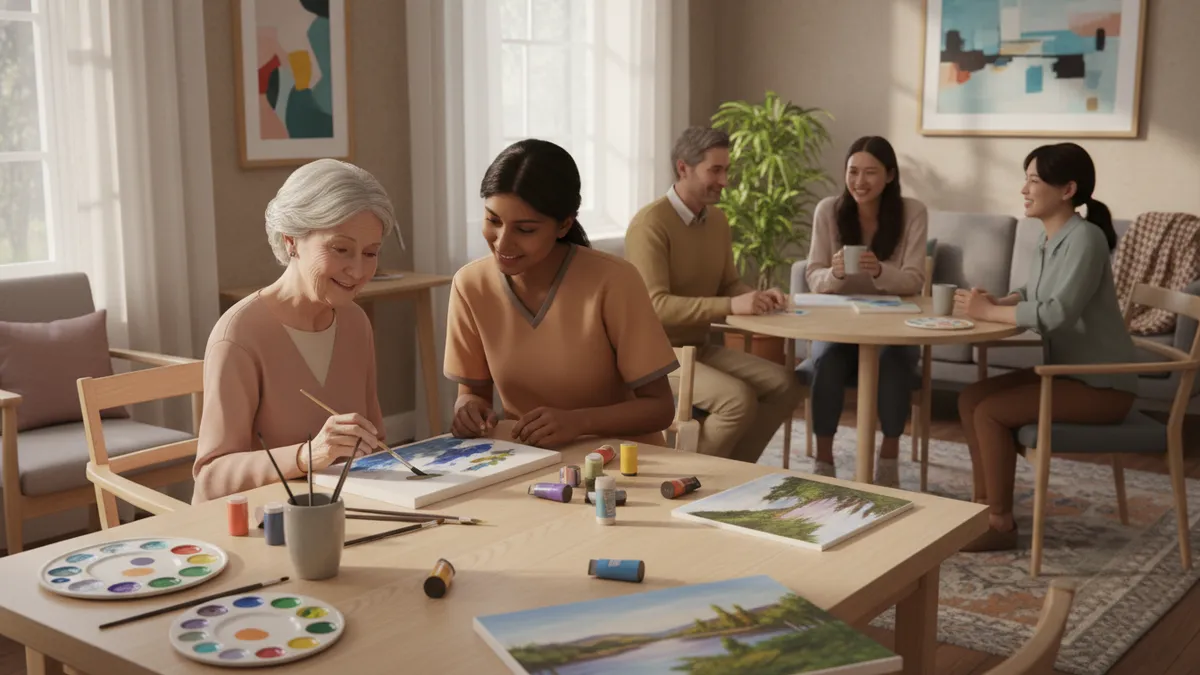
“Quite often, residents who are initially hesitant or withdrawn begin relaxing once the painting starts. Conversations begin naturally around the table, memories surface, and people who may not normally engage start encouraging each other and sharing stories.
It’s never really about creating the perfect artwork. It’s about connection, confidence, and creating a calm, positive experience together.”
That human side of creativity is difficult to measure on a spreadsheet, but families and carers often notice it immediately.
Why Creative Engagement Matters Across Ageing Conditions
Creative wellbeing activities are increasingly being used across a range of ageing-related challenges.
Dementia and Cognitive Decline
Art can provide an important non-verbal form of expression when communication becomes more difficult.
Creative activities may help stimulate memory, reduce anxiety, encourage social interaction, and create moments of familiarity and calm.
Parkinson’s Disease
Structured creative activities can support emotional expression, confidence, and adaptability while providing a calming, low-pressure outlet for people adjusting to physical and lifestyle changes.
Arthritis and Reduced Mobility
Painting, collage, and hands-on creative activities can help encourage fine motor movement, sensory stimulation, focus, and meaningful engagement.
Importantly, creative activities can often be adapted to suit different mobility levels and abilities.
Aged Care Is Changing
The aged care sector is currently undergoing one of the biggest periods of reform Australia has seen in decades.
Alongside the new Aged Care Act 2024, providers are increasingly being encouraged to deliver more structured, person-centred wellbeing programs that support emotional, social, and cognitive health, not just physical care.
That shift matters because loneliness, isolation, anxiety, and loss of confidence are increasingly recognised as important parts of the ageing experience.
Families are also looking for more meaningful ways to spend time together with ageing parents and grandparents, particularly when living with dementia or cognitive decline.
How Artful Connections Fits Into This Conversation
Artful Connections was created to make creative wellbeing feel accessible, calming, and achievable for everyone, including people who may never have considered themselves “creative.”
Every Artful Connections kit is:
- designed by qualified art therapist Deb Shapiro
- created to encourage connection and conversation
- guided step-by-step
- video supported
- ready to use at home
- suitable for families, carers, and older adults of all experience levels
Most importantly, the experience is designed to be shared.
Because the goal is never artistic perfection.
The goal is connection.
Connection to conversation.
Connection to memories.
Connection to family.
Connection to self.
And sometimes, simply connection to joy.
An Important Clarification
While art therapy is now formally recognised within the CHSP therapeutic services framework, Artful Connections is not a CHSP-funded provider, and our kits are not marketed as government-funded products.
However, the growing recognition of creative wellbeing within aged care reflects something we have believed from the beginning:
Creativity, connection, and emotional wellbeing matter deeply as people age.
And sometimes, all it takes is a quiet table, a paintbrush, and someone willing to sit beside you.
Sources & Research
- Australian Government Department of Health, Commonwealth Home Support Programme Service Catalogue 2025–27
- Australian Government, Aged Care Act 2024 reforms
- Dementia Australia, creative arts and dementia wellbeing resources
- Frontiers in Public Health, research into visual art therapy and Mild Cognitive Impairment
- Frontiers in Psychology, arts engagement and cognitive wellbeing research
- Nature Scientific Reports, art-based intervention outcomes in older adults