
How Arts on Prescription Supports Healthy Ageing
Arts on prescription helps older adults stay connected, build confidence, and support healthy ageing—beyond the first week of novelty.

Contents
The first week is easy. The third week tells you whether arts on prescription is actually working.
A lot of older adults will say yes to a creative group because they want to be helpful, polite, or simply because it is the first invitation they have had in a while. That is not the same thing as meaningful engagement. In healthy ageing work, that difference matters.
I have seen the same pattern in community rooms, aged care common areas, and small group programs around Brisbane. The first session is often all curiosity. The second is often reassurance. By the third or fourth, the real questions appear, quietly: Is this worth the effort? Do I belong here? Am I allowed to be bad at this?
That is where arts on prescription either becomes a genuine wellbeing pathway, or turns into another nice idea that people stop referring to.
What usually goes wrong after the novelty wears off
The early drop-off is rarely about “lack of interest”. It is usually about friction.
Older adults may arrive with good intentions, but the session asks too much of them too soon. A paintbrush is fiddly. A hearing loop is not available. The chair is low. The room is noisy. The instructions are spoken once and then the group moves on. Someone with mild cognitive change misses a step and feels embarrassed. Someone with arthritis cannot grip the brush properly. Someone else enjoys the social part but freezes the moment they think they are being judged on the artwork.
That is the point where a lot of programs lose people.
The fix is not more encouragement. It is less friction.
For older adults art activities to keep working after the novelty fades, the session needs to feel familiar before it feels impressive. Repetition helps. So does predictable structure. A gentle start, a clear middle, and a finish that does not require decision fatigue. The best guided creative activities for seniors I have seen do not keep reinventing the wheel each week. They give people something recognisable to return to, with just enough variation to feel fresh.
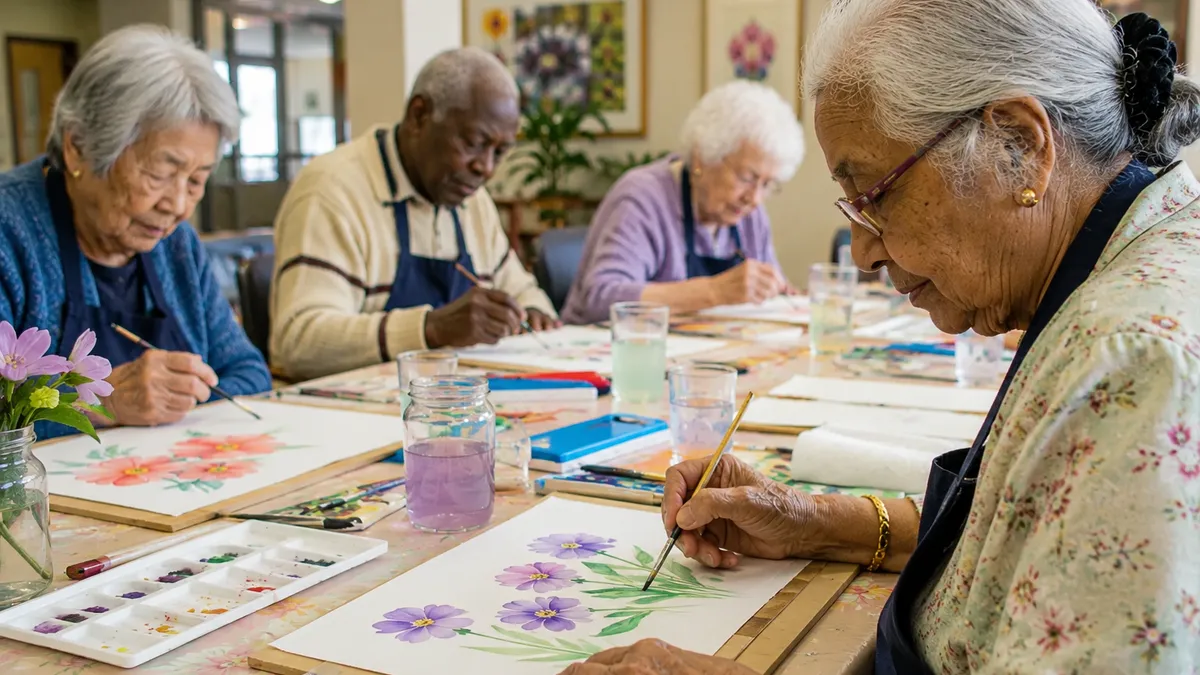
A sunlit community art table, an older woman carefully painting a pink flower while others lean over their papers, is not just a pleasant image. It shows the right conditions. Enough light. Enough room. Enough time. Enough permission to work at your own pace.
The difference between real benefit and social attendance
If someone is only attending because it is the only social thing in their week, they may still benefit, but not in the same way as someone who has begun to feel agency, calm, or confidence through the activity itself.
That sounds obvious, but it gets missed in reporting.
A participant who is genuinely benefiting usually shows at least one of these changes over a few weeks:
- they arrive a little earlier, or stop needing coaxing
- they settle more quickly
- they can tolerate small frustrations without withdrawing
- they begin making choices, even simple ones, like colour, subject, or pace
- they talk about the process at home, not just the outing
- they ask what is happening next week
Someone who is only there for contact may still enjoy the room, the tea, and the company, but the art-making part stays external to them. They might chat happily and still never quite engage with the task. That is not failure. It just means the intervention is currently functioning as a social outing, not a creative wellbeing experience.
That distinction matters for GPs, social workers, and aged care staff. If the goal is reduced loneliness, a social group may be enough. If the goal is confidence, mood regulation, or cognitive engagement, the creative component needs to be doing some real work.
Key takeaway: arts on prescription works best when the activity is not just a reason to gather, but the thing that helps people settle, connect, and feel capable again.
The hidden workload coordinators take on
Running arts on prescription across multiple aged care sites or community venues looks simple from the outside. It is not.
The hidden workload is usually in the unglamorous parts:
- checking room access, lighting, noise, tables, and chair height
- making sure supplies arrive complete and on time
- adapting for different levels of vision, dexterity, and cognition
- briefing staff so the same session is not delivered three different ways
- managing attendance lists, family consent, and care documentation
- finding a way to keep the program consistent when one venue wants “more stimulation” and another wants “something calming”
If you are coordinating across Brisbane, the geography adds another layer. A program that works in one suburb may need different transport planning, different volunteer support, or a different start time somewhere else. Even a low-cost program can become labour-heavy fast if every site needs custom preparation.
This is the biggest mistake services make when they treat arts on prescription like a low-cost add-on rather than a coordinated part of aged care wellbeing. They budget for materials, but not for the human work of making the experience safe, repeatable, and dignified.
What breaks first for people with mobility, hearing loss, dementia, or low confidence
The first thing to fail is usually not the art. It is the setup around the art.
Common pressure points
| Challenge | What tends to break first | Practical adjustment |
|---|---|---|
| Mobility issues | Reaching, holding, moving between materials | Bring supplies within arm’s reach, use stable tables, choose seated work |
| Hearing loss | Verbal instructions, group discussion | Face the group, slow the pace, use written or visual prompts |
| Dementia or mild cognitive change | Sequencing, short-term recall, confidence after a mistake | Use one step at a time, repeat calmly, avoid cluttered instructions |
| Low confidence | Fear of doing it wrong, comparing self to others | Offer guided creative activities for seniors with clear examples and no pressure to “be original” |
The important part is not to make the activity feel childish. Older adults know when they are being managed rather than supported.
So the language matters. Say “choose a colour you like” rather than “let’s do it this way”. Say “you can pause here” rather than “don’t worry if you can’t keep up”. Keep the visual reference adult, calm, and respectful. Give people enough structure to feel safe, but enough room to make a choice.
That is where dementia friendly creative activities can be especially useful. A gentle guided approach reduces the amount of memory work required and keeps the focus on enjoyment, not performance. For people with mild cognitive change, that can mean the difference between sitting on the edge of the room and actually taking part.
When the person wants the company, but not the art
This is common, and it is worth handling well.
Some older adults are not drawn to making marks on paper. They are drawn to the table, the conversation, the routine, the feeling of being included. If you push them too hard into the creative task, they often become anxious or frustrated. If you ignore the creative part completely, you lose the therapeutic value of the program.
The answer is to lower the entry point, not the dignity.
A few options work well:
- offer a very small first step, such as choosing a colour, placing a stencil, or filling one shape
- use guided painting experiences where the participant can follow along without needing to invent anything
- allow “observer participation” for a session or two, then invite a tiny action
- pair the creative task with conversation so the making does not feel like a test
- let the person stop after a short burst of effort and still count that as participation
This is where a therapist-designed format helps. A structured experience can hold the room while making room for hesitation. For families and carers, Creative Connection for Families and Carers can be a useful way to keep the focus on shared time rather than output. No setup stress. No blank page. No pressure.
Why referrals dry up after the pilot phase
The most common reason is not poor outcomes. It is poor visibility.
GPs, social workers, and aged care staff stop referring when they cannot quickly answer three questions:
- What exactly does the participant do?
- Who is it suitable for?
- How much work will it create for us?
If the answer to any of those feels vague, referrals slow down.
Pilot programs often start with goodwill. A clinician hears about something interesting, gives it a try, and the first few participants are enthusiastic. Then the pilot ends, the reporting is thin, the process is clunky, and no one is sure whether it fits frailer older adults, people with mild cognitive change, or those living at home with limited support. By then, the program has become something people mean to refer to, not something they actually do refer to.
Programs keep referrals when they are easy to describe and easy to trust. That means clear inclusion criteria, simple referral pathways, and enough consistency that staff know what happens after the referral leaves their desk.
When arts on prescription is no longer the right fit
There are times when creative wellbeing is not the best next step.
If a person is in acute distress, actively psychotic, severely depressed, medically unstable, or unable to tolerate a group environment at all, a creative session may be too much. If the person becomes more distressed by the materials than soothed by the process, that is useful information, not a failed referral.
Experienced practitioners usually switch to one of three things:
- a quieter one-to-one support option
- a more structured social activity without creative demand
- a different therapeutic or clinical pathway, depending on risk and presentation
For older adults, that might mean moving from a group-based arts on prescription program to a smaller supported visit, a reminiscence-based conversation, a sensory activity, or a referral back to the GP, mental health clinician, or aged care team. The right intervention is the one the person can actually use.
Healthy ageing is not about forcing everyone into the same activity. It is about matching the level of challenge to the person in front of you.
What good programs do differently
The strongest arts on prescription programs I have seen do a few things consistently.
They are built for repeatability, not just a nice first session. They are designed with older adults in mind, including people with low confidence, hearing loss, arthritis, and mild cognitive change. They reduce preparation for staff and carers. They make it easy to begin, because starting is often the hardest part.
They also leave room for conversation without making conversation the whole point.
That balance matters. Too much focus on the artwork and people feel judged. Too much focus on the social side and the creative benefit gets diluted. The sweet spot is a calm, guided experience that gives people something to do with their hands while the room slowly opens up around them.
In Brisbane, that kind of low-pressure, high-dignity model makes sense in community health, home care, and aged care settings alike. It is practical. It is portable. And it respects the fact that older adults do not need to be entertained. They need to be met properly.
A simple way to check whether your program is ready
Before you refer or roll out another round, ask these five questions:
- Can someone join even if they are anxious, slow, or unsure?
- Can the session still work if hearing, vision, or mobility is limited?
- Is the creative task clear enough to follow without a lot of explanation?
- Would a coordinator be able to run this in more than one site without rebuilding it each time?
- Can you tell, after three sessions, whether the person is actually benefiting?
If the answer is no to most of those, the program may be pleasant, but it is not yet ready for sustained healthy ageing work.
If you want a ready-made option that removes a lot of the setup and keeps the experience structured, Guided Creative Wellbeing Experiences are built for that kind of use. They include complete supplies and video guidance from Debra, so staff and families are not starting from scratch. If that would save you time, see how it works and use it as the faster path.
For everyone else, start by tightening the basics. Make the room easier. Make the instructions simpler. Make the first step smaller. That is usually where arts on prescription either begins to work, or finally starts to last.