
How to Simplify or Stop an Activity Format

Contents
The halfway point tells you more than the start ever will
When a person keeps getting halfway through a collage and then drifting off, the problem is usually not “motivation” in the abstract. It is usually one of four things: the task has gone on too long, the materials are asking too much, the choices are too broad, or the format no longer feels worth finishing.
That last one matters more than people like to admit. In aged care work, we often try to rescue a collage by making it simpler, but there is a point where simplifying stops helping and the activity starts losing its shape. If you keep trimming and trimming, you can end up with something that is no longer a collage at all, just a different craft with a familiar label.
I have seen this in home visits, in Brisbane community groups, and in aged care rooms where the table is set beautifully and the person still checks out after ten minutes. The set-up was not the whole issue. The format was.
First, work out whether this is tiredness or true disengagement
Tiredness has a pattern. Lost interest has a different one. If you can tell them apart early, you stop blaming the person for something the activity caused.
Tiredness usually looks like this:
- Slower hands, but still some willingness to continue
- More pauses, but the person responds when you reduce the pace
- Less talking, less eye contact, maybe a lean back in the chair
- They may accept help, a drink, or a short break and then return
Disengagement looks different:
- They stop looking at the materials
- They start tidying, folding, or moving pieces around without choosing anything
- They answer with “whatever you think” or “I don’t mind” very quickly
- They may become mildly irritable, or simply go flat
The easiest test is a small one. Offer a genuine pause, not a rescue. Say, “Would you like to stop for now and come back later?” If they brighten, that was fatigue. If they look relieved and do not come back to it, the activity has probably lost them.
That distinction matters because a tired person may benefit from a shorter session. A person who has disengaged halfway through is telling you something else: the format is not holding meaning.
What usually fails first
When the same type of art materials keep bringing the person to a halt, the first thing that usually stops working is the level of choice. Too many options can quietly become too much thinking.
With collage, people often assume the issue is the length of the session. Sometimes it is. But in my experience, the first crack is often choice overload, especially if the person is living with mild cognitive change or dementia. If they are faced with ten papers, six glue options, and a blank page, the task becomes a decision-making exercise before it becomes a creative one.
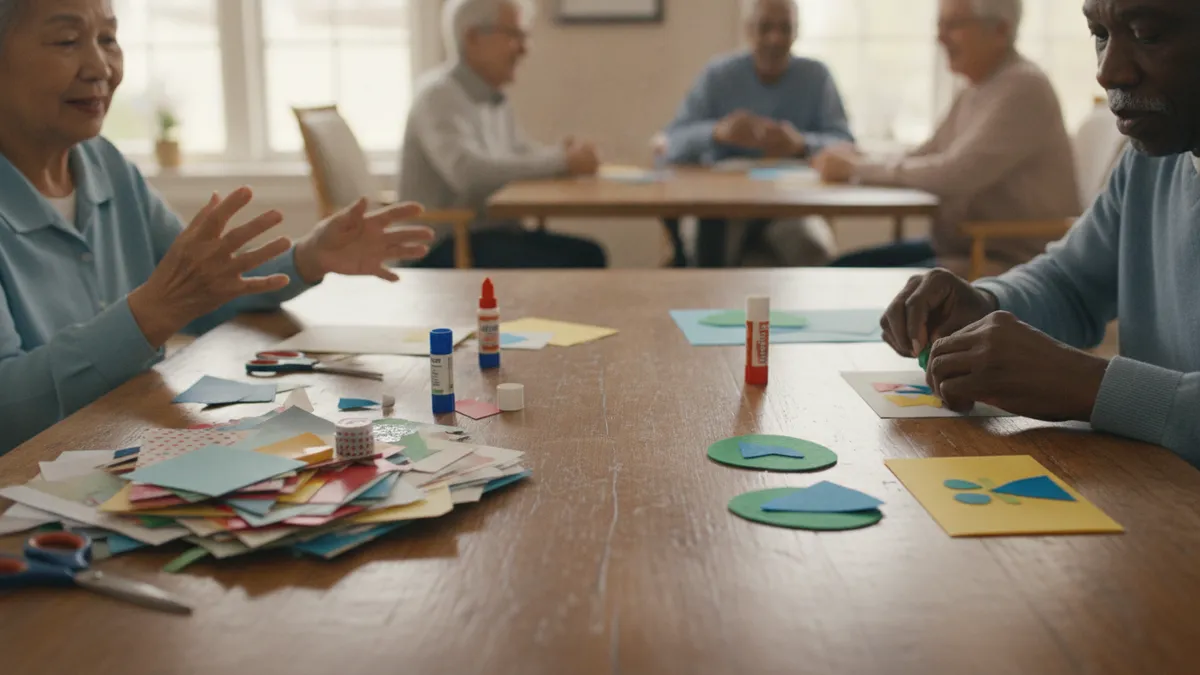
Then the materials become the next problem. Collage asks a person to sort, select, place, and commit. That is a lot of switching. Scissors, glue sticks, small cut-outs, and layered decisions can be tiring even for someone who enjoys making things.
Task length matters too, but usually after the other two. If the task is meaningful and the materials are clear, people will often stay with it longer than you expect. If the choices are muddy or the materials are fiddly, a short session can still fall apart.
Key takeaway: If someone disengages every time, do not assume they need more encouragement. Often they need less choice, less handling, and a clearer finish line.
When simplifying helps, and when it just changes the activity
There is a real difference between simplifying an activity and quietly replacing it with something else. Once you cross that line, it is worth naming it honestly.
A collage can be simplified by:
- Reducing the number of material options
- Pre-cutting shapes
- Offering one clear theme
- Limiting the time to a small, contained session
- Showing a finished example without asking for a copy
But if you remove the cutting, remove the arranging, remove the decision-making, and remove the layered composition, you are no longer really doing collage. You may have moved into colouring, sticker placement, or a guided picture-making task.
That is not a failure. It just means the original format is no longer the right fit.
This is the point where many staff keep pushing because they feel they should preserve the original activity. In practice, that can create more frustration than flexibility. When collage activities lose meaning, the win is not keeping the word “collage” alive. The win is keeping the person engaged in a way that still feels calm, possible, and worthwhile.
What experienced staff change first
When someone keeps dropping out midway through a collage session, the first thing experienced staff usually change is the setup, not the expectation. The room, table, and materials often tell you more than the instructions do.
Start here:
-
Simplify the table Remove everything that is not needed for this exact session. If the person can see extra paper, extra glue, or leftover scraps, they will often start sorting instead of creating.
-
Reduce the decision load Offer two or three options, not ten. One background, a small pile of pre-cut images, and one glue stick is often enough.
-
Shorten the first win Give them a task that can be finished in a few minutes. A small card, a single page, or one section of a larger image works better than a full sheet waiting to be filled.
-
Change the instructions Keep them concrete. “Stick these three flowers here” is easier than “make your own spring scene.”
-
Drop the expected outcome If the person feels they must produce something neat or complete, they may stop before they start. A finished result is not always the goal. Sometimes the goal is simply to stay with the activity long enough to feel settled.
That order matters. If you start by changing the desired outcome, you may miss the real problem in the setup.
The line where simplification becomes a different activity
You have crossed the line when the person is no longer making choices that belong to collage. Collage depends on selecting, placing, layering, and adjusting. If those parts disappear, the activity has changed.
A few signs you have gone too far:
- The person is only sticking pre-set pieces into one fixed spot
- There is no real arranging, just filling
- You are doing most of the composition for them
- The activity becomes more about following directions than creating something personal
At that point, you are not simplifying collage, you are converting it into a guided craft. That may still be useful. In fact, for some people it is the better option. But it should be chosen deliberately, not by accident.
This is where an activity format decision becomes practical rather than philosophical. Ask, “Is this still giving the person the kind of creative control that matters to them?” If the answer is no, stop calling it collage and choose the format that actually fits.
Persist in smaller doses, or move on?
If the person disengages halfway through once or twice, I would simplify and test again. If it happens repeatedly across different days, I would stop using that format. Repetition is the clue.
Persist in smaller doses when:
- The person used to enjoy this kind of task
- They can still talk about the images or theme
- They re-engage if you shorten the session
- The issue seems tied to fatigue, not resistance
Switch formats when:
- They disengage at the same point every time
- The same materials seem to trigger the drop-off
- They show no interest in the finished result
- They become unsettled when the collage materials come out
If the same pattern keeps repeating, the activity is telling you something. When collage activities lose meaning, smaller doses can become a way of delaying the obvious. Sometimes the kindest move is to stop using that format and replace it with something that asks less of the person.
What tends to work better than collage
The best replacement formats are usually more contained, more guided, and less dependent on sorting and fine decision-making. You are looking for calm engagement, not a perfect art lesson.
These often work better:
| Format | Why it works better | Best fit |
|---|---|---|
| Guided painting | One clear path, less sorting, less mess | People who want a finish without lots of choices |
| Colouring with large shapes | Familiar, low pressure, easy to pause | People who like repetition and visual calm |
| Sticker or pre-cut picture placement | Still creative, but less demanding than collage | People who like simple matching and arranging |
| Shared painting with prompts | Good for conversation and connection | Family carers and group settings |
| Short themed creative kits | Clear start and end, low preparation | Aged care rooms and home visits |
For many people, guided painting is the cleanest swap. It keeps the creative feeling without asking them to manage the same amount of decision-making as collage. That is why products like Creative Engagement for Older Adults can be useful in Brisbane homes and aged care settings, especially when you need something low-prep and easy to begin rather than another table full of loose pieces.
If the person is living with mild dementia or just gets overwhelmed by open-ended tasks, a gentler option such as Dementia Friendly Creative Activities may fit better than trying to rescue a collage that has already stopped working.
A simple decision rule you can actually use
Use this rule: if the person can still choose, place, and stay with the task in a way that feels calm, simplify. If they cannot, change the format. That is the activity format decision in plain language.
Before the next session, ask yourself:
- Did they disengage because they were tired, or because the task lost them?
- Did simplifying the setup make any difference?
- Are they still making meaningful choices?
- Is the activity helping them settle, or creating quiet resistance?
If the answer keeps coming back to resistance, do not keep polishing the same format. Move to something more guided and less demanding.
In Brisbane aged care work, that often means replacing a collage table with a short painting session, a themed creative kit, or a shared activity that gives the person a clear beginning and end. The aim is not to force creativity. It is to support engagement in a way that still feels dignified.
If you need something easier to begin
When collage activities lose meaning, the fastest fix is usually a format with less setup and a clearer path through it. That is where guided creative experiences earn their place.
If you are supporting an older adult at home, in a community program, or in aged care, Creative Engagement for Older Adults is built for exactly that kind of low-preparation use. It gives you step-by-step guidance and complete materials, which means less table-filling and less time trying to improvise a rescue plan.
For families and carers who want something that does not turn into another stressful afternoon, Creative Connection for Families and Carers can be a simpler way to keep the focus on shared time rather than the craft itself.
The quiet skill is knowing when to stop
Stopping a format is not giving up on the person. It is paying attention to what the person is already telling you. That is the part many carers and support workers do well, even when they doubt themselves.
If the person is tired, shorten it. If they are overwhelmed, simplify it. If they keep disengaging halfway through no matter what you change, stop using that format and choose one that fits their energy, attention, and comfort better.
That is how you support engagement without forcing it.
If you want a ready-to-use alternative, start with Creative Engagement for Older Adults and see whether a guided, low-prep format gives you the calmer response you have been trying to create.