
What Should I Do When a Senior Refuses to Share?

Contents
When one person takes over the art table, stop treating it like a manners problem
A senior who refuses to share in a group art session is rarely just being “difficult”. More often, they are trying to protect something, control, status, certainty, pride, or the fear of looking lost in front of other people.
That matters, because the wrong response turns a tense moment into a family project conflict or a room full of embarrassed silence. And once the group starts watching who gets the good brushes, the whole activity can tip from shared creativity into a power struggle.
If you’ve ever run a senior hoards art materials project, you already know the pattern. One person claims the paints, corrects everyone else’s choices, or quietly rewrites the whole thing so it looks like their work. The group goes quiet. Then the staff member or volunteer spends the next 20 minutes trying to “keep the peace”.
That’s the part to change.
First, work out what you are actually dealing with
Not every refusal to share means the same thing, and your response should not be the same either. A person who is anxious will behave differently from someone who has always been controlling, and both look different again if there is mild cognitive change in the mix.
Here’s the quick read I use.
| What you see | What it may mean | What usually helps |
|---|---|---|
| They share fine one-on-one, but dominate in groups | Status anxiety, performance pressure, old role habits | Smaller roles, clearer boundaries, less public correction |
| They hoard the best materials | Fear of scarcity, perfectionism, loss of control | Duplicate supplies, named sets, visible turn-taking |
| They become offended when redirected | Shame, feeling singled out, loss of face | Quiet reset, private conversation, no public debate |
| They forget whose turn it is or repeat the same demand | Cognitive decline, reduced flexibility, short-term memory issues | Simplified setup, fixed roles, fewer choices |
| They only do it in familiar family settings | Long-standing family dynamics | Change the structure, not just the script |
If the same person is warm and cooperative in a one-on-one conversation but controlling in a group, do not assume they are being manipulative in a simple sense. Group settings bring up comparison. Some people start performing competence the moment there are witnesses.
If there is a known diagnosis, or you’re noticing new rigidity, repeated questions, or trouble shifting gears, read it as possible cognitive change rather than stubbornness alone. That doesn’t excuse the behaviour, but it changes your aim. You are not trying to win an argument. You are trying to keep the activity usable.
For more on the mood side of this, see Why Do Aging Parents Become More Irritable? Explained.
Key takeaway: When the behaviour shifts with the setting, change the setting before you try to change the person.
The fastest reset is not a lecture, it is a better layout
When a senior starts hoarding the good supplies or rewriting everyone else’s part of the project, the quickest fix is to remove the opportunity for control, not argue about fairness in front of the group.
That means changing the setup immediately.
Do this in the room, not after the fact
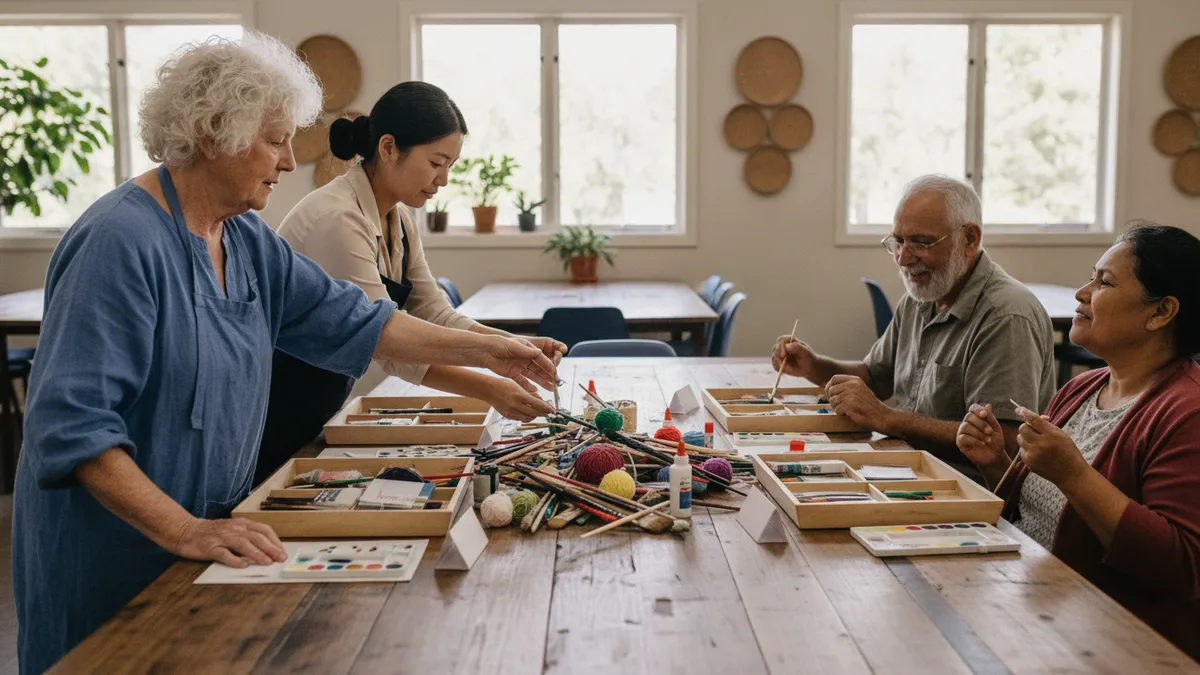
- Put out one kit per person, or one clearly labelled set per table.
- Keep the most tempting items out of shared reach.
- Give each person a defined job before the materials come out.
- Use a timer or a simple turn card if you need turn-taking.
- If one person keeps taking over, move them to a separate but equal task for that session.
This is where a senior hoards art materials project often goes wrong. People wait too long because they do not want to seem rude. So the person who is controlling gets more confident, the others get quieter, and by the third session you’re not managing an activity anymore, you’re managing territory.
The fix is not to shame them. It is to make the boundary boring.
Say it plainly, once:
- “These brushes stay with this side of the table.”
- “You’ve got the blue set, and Joan has the red set.”
- “Your job is the background, not everyone’s whole page.”
- “We’re keeping each person’s piece separate today.”
Then move on. No speech. No public negotiation. No open-ended “Can we all share nicely?” That script sounds fair, but it leaves too much room for one person to take the floor.
When the issue is anxiety, perfectionism, or status, turn the task into a role
Sometimes the materials are not the real issue. The person is anxious about making a mistake, or they need to feel useful, or they are protecting a role they’ve held for years, the organiser, the fixer, the one who knows best.
If you answer that with “let’s take turns”, it can backfire. They hear, “You’re no longer in charge.” Then the refusal hardens.
A better move is to give them a respected role that has limits.
Good roles are specific and finite
Try:
- colour chooser for the first two minutes
- brush washer
- title writer
- story starter
- pattern matcher
- finished-piece photographer
These roles keep dignity intact without handing over the whole project. That is the balance you want in shared creativity. They still matter, but they cannot monopolise the pace, the materials, or the decisions.
If you are running activities in Brisbane aged care settings, this is often the difference between a room that settles and a room that spirals. A person who needs status can usually tolerate boundaries better when they are framed as a job, not a correction.
For family sessions, this also helps with the classic “I’m just trying to help” version of control. Assign the helper task before the supplies come out. Then the person is less likely to start editing everyone else’s work mid-stream.
If one person has been running the activity for weeks, don’t announce a takeover
This is where people get stuck. They’ve let one participant run the whole project for a few sessions, then realise the group is drifting. They try to take control back in one big correction, and the person feels exposed.
That is usually when the pushback gets worse.
If you need to reclaim the structure, do it by changing the routine, not by calling out the person. Start with the setup, not the behaviour.
Use a neutral reset
- Bring in a new format and present it as the new activity for everyone.
- Change who distributes materials.
- Put the instructions on the table before anyone picks up a brush.
- Use templates so no one can “fix” the whole piece from the start.
- Rotate roles as part of the activity design, not as a response to one person.
This is especially useful after a senior hoards art materials project has already been happening for a while. The goal is to make the old pattern impossible without making the person feel targeted.
If you need to say something directly, keep it about the group structure:
“We’re changing how this one works so everyone gets a clear part.”
That sentence does a lot of work. It removes the spotlight. It signals a new boundary. And it does not invite debate.
When the first attempt fails, expect the next reaction to be more rigid
If you’ve already tried to redirect them once and they came back more offended, do not keep repeating the same request. Repetition without a change in setup just turns into a contest.
What usually happens next is one of three things:
- They dig in harder because they think you are challenging them.
- They act hurt and withdraw, which can look like sulking or refusal.
- They wait until you’re busy and then take over again.
That’s why the second response needs to be different from the first. Less talking. More structure.
Try this sequence
- Acknowledge the feeling without agreeing to the behaviour.
- Restate the boundary in one sentence.
- Redirect to a concrete task.
- Change the materials or seating if needed.
Example:
- “I can see you wanted to keep that part together.”
- “Today everyone is doing their own section.”
- “Could you start with the leaves on this template?”
- “I’m moving the paints to the centre so each person has their own tray.”
That is how you handle controlling behaviour without turning it into a public fight.
If the person is still escalating, stop negotiating. Move to a duplicated setup or separate project. Waiting too long usually means the group has already adjusted around the controlling person, and now you’re not just changing materials, you’re changing expectations. That’s harder.
Separate the project before the group starts separating itself
There is a point where negotiation stops being useful. You can usually see it when:
- the same person repeatedly takes the best supplies
- other participants stop speaking up
- staff are spending more time policing than facilitating
- the activity only works when one person is absent
- the room feels tense before the materials even come out
That is the moment to stop trying to preserve one shared project at all costs.
Split the activity instead. Give each person a parallel version. Use matching templates. Use separate supply packs. Let people work side by side, not on the same surface.
This is not a failure. It is a better design.
For older adults with mild cognitive change, this can be the difference between participation and shutdown. The blank page, the shared paint pots, the open-ended “work together” instruction, all of that can become too much. A more structured format reduces the chance that one person will take over just to cope.
That is one reason Painting Kits for People Living with Mild Dementia can work well in group or family settings. The templates remove the blank page, the video guidance can be paused and replayed, and the brushwork is forgiving for unsteady hands. In practical terms, that means less competition over who is “doing it right”.
If you need everyone to feel respected, build the respect into the task
A shared creative activity does not have to mean shared supplies. It can mean shared time, shared theme, shared conversation.
If you are trying to reduce family project conflict, this is the cleanest way to do it:
- give each person their own materials
- use the same theme across the group
- let each person tell their own story through the work
- bring everyone back together at the end to show and talk about the pieces
That last part matters. People who fear losing status often calm down if they know there will still be a moment where their work is seen.
For families, that can be the difference between a tense afternoon and something worth repeating. For aged care staff, it keeps the group inclusive without forcing false togetherness.
If you need a self-serve option that already bakes this structure in, Painting Kits for Adult Children and Their Parents are built around exactly that problem, one box with everything inside, three templates so there is no blank page, and step-by-step video guidance from Deb. It is a cleaner fit for a home visit than trying to improvise a shared project from whatever is in the cupboard.
When the behaviour is really about the person, not the paint
Sometimes the refusal to share is tied to identity. The person may have spent a lifetime being the organiser, the one with the best eye, the one who kept things moving. Losing that role can feel like losing themselves.
That is why the usual “please share” line sometimes lands badly. It sounds small, but to them it can feel like a demotion.
So keep the dignity, remove the monopoly.
- Ask for advice once, not continuously.
- Let them choose a theme, not every step.
- Give them a visible role, not total control.
- Use a fixed end point so the activity cannot be stretched to suit one person.
That approach works whether you are in a family lounge room, a support at home visit, or a Brisbane community group where the same participant has started to control the whole table.
The practical rule that saves most sessions
If the person can share one-on-one but not in a group, treat it as a group design problem.
If the person gets more rigid after correction, stop correcting in the moment and change the setup.
If the person hoards supplies, duplicate or separate them.
If the person needs status, give them a role with boundaries.
If the activity keeps collapsing into one person’s project, stop calling it a shared project.
That is the real answer to a senior hoards art materials project. Not better manners. Better structure.
What to do next
Before the next session, decide which of these you need:
- a shared table with clearly assigned roles
- duplicated supplies and separate templates
- a fully separate project for each person
- a quieter one-on-one creative activity instead of a group one
Then set that up before anyone sits down. Do not wait to see if the old pattern repeats. It probably will.
If you want the faster path, use a kit that already removes the blank page, the supply grabbing, and the need to improvise. Painting Kits for Aged Care and Support at Home Providers are made for one resident per box, so there are no shared materials to fight over, no facilitation training needed, and they still work when the activity room is closed or the session has to happen in-room.
That is the cleanest way to keep the focus where it belongs, on the conversation, the reminiscence, and the part of the afternoon people actually remember.