
What to Do When Painting Sessions Go Quiet

Contents
When the room goes quiet, don’t rush to fill it
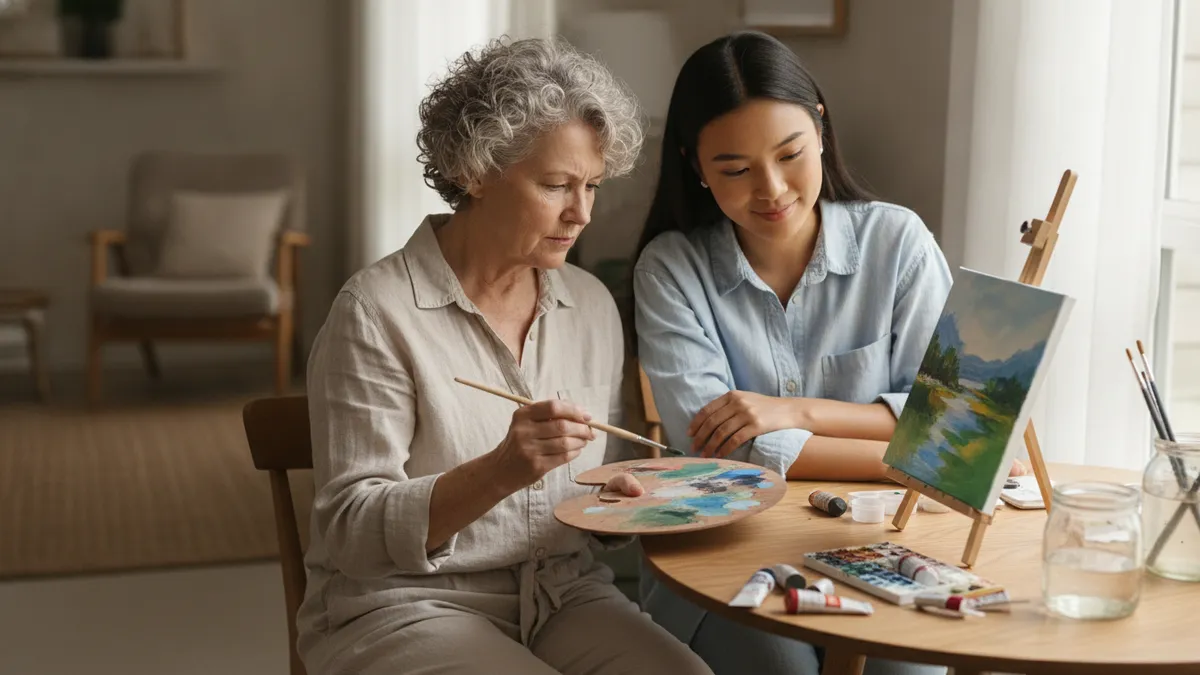
A painting session that goes quiet is not automatically a problem. Sometimes it is the point.
If you have found yourself wondering, “What do I do when the painting session keeps going quiet and the older adult seems happier with the silence than with talking?”, the answer is usually simpler than people expect: slow down, stop performing connection, and watch what the silence is doing. In a lot of homes, a quiet painting session is not a sign that something has gone wrong. It is the first time in the day that nobody is asking anything of them.
That can feel uncomfortable if you came in hoping for a warm chat and a bit of bonding. It can also feel like failure. But older adult silence during a senior painting activity often means the person has finally found a pace that feels safe enough to settle into.
Read the silence before you try to fix it
The first mistake is assuming that quiet means disinterest. It usually does not.
A person may be fully engaged while saying very little. Their hands are moving, they are choosing colours, they are looking closely at the template, they are pausing to think. That is still participation. In fact, for some people, especially those who feel self-conscious, a silent art activity is easier than a conversation they have to keep up with.
Key takeaway: If the painting is steady, the breathing is easy, and the person seems settled, the silence may be the most comfortable part of the session.
What you are looking for is not words. It is whether the older adult seems calm, present, and willing to keep going.
Signs your talking is making it worse
There are a few early signs that your conversation is getting in the way, even if they are still being polite:
- they answer with one-word replies and do not extend the conversation
- they keep painting but stop looking up
- their shoulders lift or their jaw tightens when you ask another question
- they start using “mm” or “yeah” without much expression
- they slow down after you begin talking more
- they seem more focused again once the room quietens
That last one is the clearest clue. If the session feels lighter the moment you stop filling it, believe that signal.
If silence is working, stop trying to earn the moment
The hardest part for adult children is often this: you came in planning a bonding activity, and now the bond looks nothing like you imagined. No deep talk. No reminiscence. No neat emotional breakthrough.
That does not mean the visit is empty.
For many families, especially when time is short and visits are rare, there is pressure for every shared activity to prove something. But connection does not have to be verbal to be real. Sitting side by side, choosing a colour, and working on the same picture can be enough. That is often what people mean when they say they want quality time, even if they never say it plainly.
If you are still asking, “What do I do when the painting session keeps going quiet and the older adult seems happier with the silence than with talking?”, the honest answer is to let the silence do some of the work. You do not need to rescue it.
What to say instead of filling every gap
Use fewer words, not more. Try prompts that are light and optional:
- “That blue looks lovely.”
- “Do you want this brush or the smaller one?”
- “I’m just going to sit with mine for a bit.”
- “Which colour are you feeling today?”
Then stop. Give them room to answer, or not answer.
That is especially useful when you are supporting someone who may be living with mild cognitive change or dementia. Requiring constant conversation can turn a gentle creative session into a test. The more it feels like a test, the faster people retreat.
When quiet one day and withdrawal the next are not the same thing
This is where caregivers get stuck. The same person who painted happily in silence last week can seem flat, withdrawn, or unresponsive this week. Those are not the same thing, and it matters.
A good quiet session usually still has some signs of engagement:
- they reach for materials
- they make choices, even small ones
- they keep returning to the page
- they settle into the rhythm of the task
- they seem content when you stay nearby without talking much
Withdrawal looks different. They may leave the brush untouched, stare at the table, seem unusually tired, or show no interest in the activity at all. If that happens, the issue may not be silence. It may be fatigue, pain, grief, medication effects, low mood, or simply a bad day.
If you want a useful comparison, think about it this way: silence can be comfortable. Disengagement usually looks heavier.
Change the setting before you blame the person
Before you decide the quietness is about the activity itself, change the setup. Not everything needs to be redesigned, but a few small adjustments can tell you a lot.
Try these one at a time:
- Lighting: natural light or a softer lamp often helps more than overhead glare
- Seating: make sure they are comfortable and not reaching awkwardly across the table
- Materials: larger brushes, thicker handles, and pre-set colours can reduce effort
- Pace: slow down the instructions and remove any sense of rushing
- Sound: some people like soft music, others find it distracting
- Table height and distance: if they are leaning or stretching, the activity will feel harder than it should
If the session settles after one of these changes, the quiet was probably not the problem. The friction was.
That is particularly true in Brisbane homes where the room might be hot in the afternoon, too bright, or simply not set up for long sitting. A small adjustment in shade, fan, or table placement can change the whole feel of the session.
Measure meaning without making them perform it
If the older adult clearly prefers silence, how do you know the session is still meaningful?
Look for signs of ease, not conversation. Meaning in a painting session can be measured in tiny things:
- they stay longer than expected
- they return to the activity after a pause
- they choose colours with interest
- they smile at a finished section
- they keep the work nearby after the session
- they seem calmer afterwards than before
That is enough.
You do not need a spoken reflection to prove the visit mattered. A quiet painting session can be deeply connected precisely because nobody is being asked to explain themselves. For some people, especially those who are tired, anxious, or living with cognitive changes, that is the safest way to be with another person.
If you are looking for a low-pressure structure that removes the blank page and the pressure to talk, Painting Kits for Adult Children and Their Parents were designed for exactly that kind of time together. Everything is in the box, including three templates and step-by-step video guidance from Deb, so you are not scrambling to make the moment work.
When talking keeps getting in the way, change your role
A lot of adult children walk into these sessions thinking they need to be the host, the entertainer, and the conversation keeper. That is too much.
Your job is smaller than that. You are there to make the space feel steady, not busy. You are there to notice what helps and what does not. You are there to be present without making the older adult carry the emotional labour of the visit.
If you keep asking, “What do I do when the painting session keeps going quiet and the older adult seems happier with the silence than with talking?”, one good answer is to become less of a narrator and more of a companion. Sit beside them. Match their pace. Let the work lead.
That shift matters in family homes, but it matters just as much in aged care. Support workers and activity coordinators in Brisbane see this all the time. A resident who ignores group chat might paint happily when the room is calmer, the materials are simple, and nobody is asking them to explain what the picture means.
When silence is the right fit, keep the activity simple
Not every activity can carry silence well. Painting can, if the setup is right.
The best silent sessions usually have three things in common:
- No blank page. People do better when they are not starting from nothing.
- Clear guidance. A short demonstration or video lowers the pressure.
- A forgiving outcome. The activity should still feel okay if the brushwork is uneven or the colours are not perfect.
That is why some older adults settle more easily into guided painting than into open-ended craft. They are not being difficult. They are avoiding failure.
For people living with mild dementia, this matters even more. A quiet, structured activity can reduce social anxiety and cut out the need for memory recall or quick responses. The Painting Kits for People Living with Mild Dementia are built around that idea, with self-paced video guidance and templates that remove the blank page.
If the silence feels awkward to you, name that honestly
Sometimes the awkwardness is not theirs. It is yours.
You may be sitting in a quiet room thinking, “This feels flat,” when the older adult is actually settled and content. That mismatch is common. We are trained to read conversation as connection, so silence can feel like something missing even when nothing is missing at all.
The fix is not to force cheerfulness. It is to tolerate the slower shape of the moment. If you can stay present without performing, you give the other person permission to do the same.
That is often the difference between a session that feels forced and one that feels restorative.
When to leave the quiet alone
So when should you stop trying to fill the room with conversation?
Stop when:
- they seem calmer when you are quiet
- their hands keep working without prompting
- your questions are getting shorter answers
- the room feels settled rather than tense
- the silence does not look like distress
Keep checking in gently if:
- they seem confused
- they stop engaging altogether
- they look uncomfortable, tired, or in pain
- the quiet feels heavy rather than restful
If the activity is still going well, let it stay quiet. That is not you giving up. That is you reading the room properly.
A simple way to handle the next session
Before the next painting session, set it up so silence is allowed from the start:
- put out the materials before they arrive
- choose a template rather than a blank page
- sit beside, not across from, if that feels less like an interview
- begin with one simple comment, then pause
- keep music low or skip it entirely if they seem distracted by sound
- watch their body language more than their words
If the session stays calm and they keep painting, you have your answer. The quiet is working.
And if you want the easier path, not the harder one, use a kit that already removes the parts that create pressure. For families who want something ready to open and start, Painting Kits for Adult Children and Their Parents are designed to do exactly that, with everything in one box and step-by-step video guidance from Deb.
Related reading
If the activity itself starts to feel like too much, see What to Do When a Low-Energy Activity Hurts Parent.
If you are choosing a format for someone with memory changes, painting kits for mild dementia can help you set things up with less pressure.
For care teams and providers, painting kits for aged care and support at home providers are built for one resident, one box, and no facilitation training.
The quiet is not the problem
A silent art activity is not a failed conversation. It is often a better one, just without words.
If you have been wondering, “What do I do when the painting session keeps going quiet and the older adult seems happier with the silence than with talking?”, start by trusting what you can see. If they are settled, engaged, and content, leave the silence alone. If they are withdrawing, change the setup and look for the real cause.
For the next session, keep it simple: fewer questions, softer pace, better seating, no blank page. Then watch what happens when nobody is trying to force the moment.
If you want that kind of gentle structure ready to go, start with Painting Kits for Adult Children and Their Parents.